

You know how kids will spend hours building lego castles or on tablets when they were supposed to be cleaning their room? They were “busy”, but they didn’t do what actually needed to get done.
That’s most farmers.
We’re busy from sunrise to sunset. But are we doing the things that actually make our farms profitable?
What is the Eisenhower Matrix?
President Eisenhower had a quote: “What is important is seldom urgent, and what is urgent is seldom important.”
The guy ran World War II operations and then the country. He had to figure out what actually deserved his attention versus what just felt urgent.
So he created a simple tool. A four-square grid that helps sort every task by asking two questions:
- Is this urgent? (Needs to be done NOW)
- Is this important? (Actually moves the needle)
Here’s how I adapted it for farming, because honestly, on a farm, EVERYTHING feels urgent.
The Farm Version: Draw Your Matrix
Grab a piece of paper. Draw a cross. Four squares. Label them like this (see example below):
ACROSS THE TOP: “Important” on the left, “Not Important” on the right
DOWN THE SIDE: “Urgent” on top, “Not Urgent” on bottom
Now you’ve got four squares:
Top Left – URGENT + IMPORTANT
Top Right – URGENT + NOT IMPORTANT
Bottom Left – NOT URGENT + IMPORTANT
Bottom Right – NOT URGENT + NOT IMPORTANT
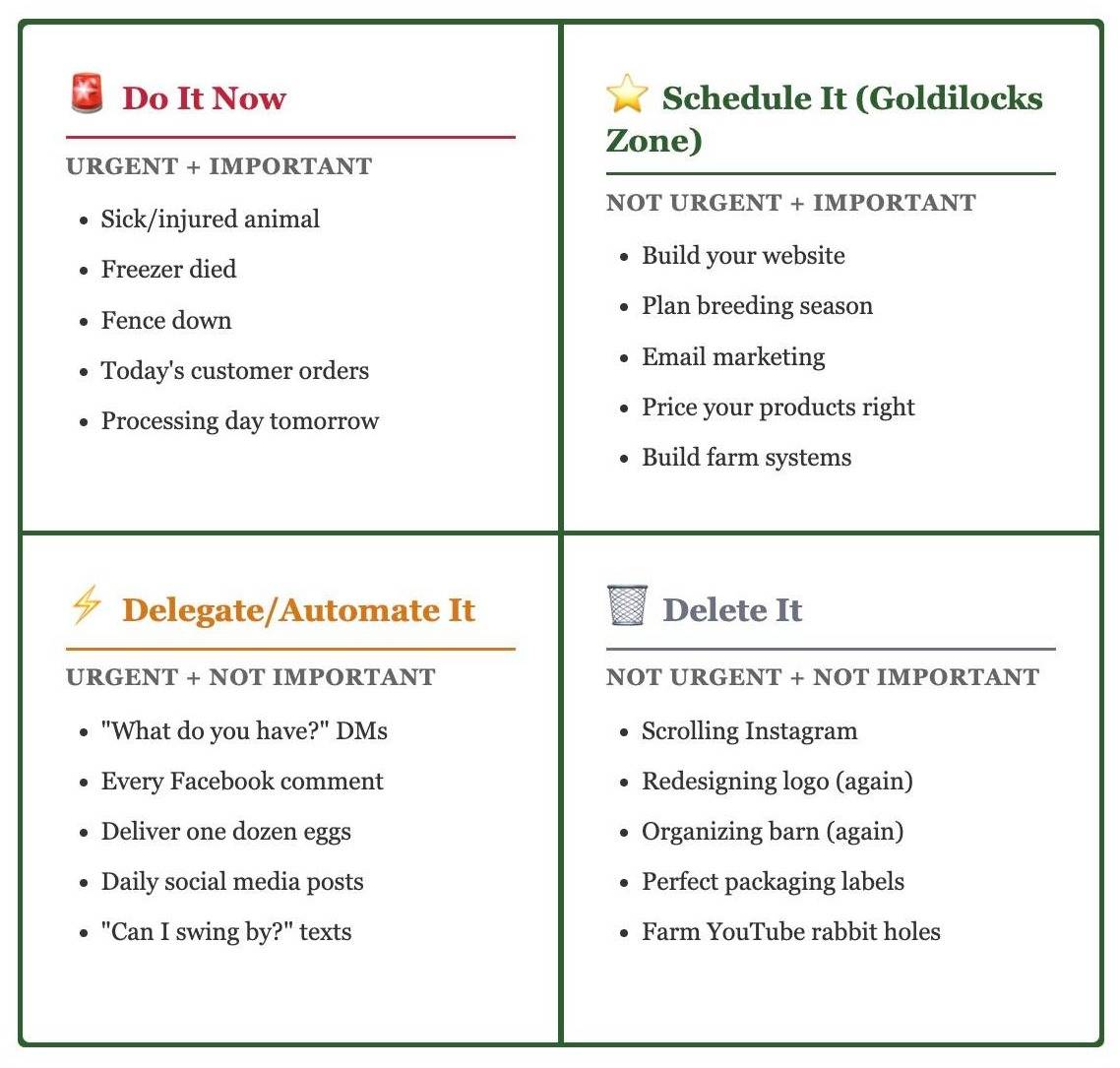
It should look like this AI diagram. My writing is too messy and I couldn’t find one related to farms, but this should convey the general idea.
Let me explain each square in farmer terms.
Square 1: Urgent + Important (Do It Now)
These are your farm emergencies and critical deadlines.
Examples:
- Animal is sick/injured and needs immediate care
- Freezer died and meat needs to be moved NOW
- Customer placed an order for pickup tomorrow.
- Processing day is tomorrow and birds aren’t caught
- Fence is down and animals are out
- Invoice due today to avoid late fee
What to do: Handle these immediately. This is where your attention belongs when something lands here.
The trap: These are common sense and you don’t need a box to tell you these need doing, but some farmers live their entire farm life in this square. Constantly in crisis mode, putting out fires. That’s chaos and quick way to turn your farm dream into a nightmare.
The goal: Keep this square as empty as possible through better planning (see Square 2).
Square 2: Not Urgent + Important (Schedule It – This is the Goldilocks Zone)
This is where profitable farms are built. The stuff that matters but doesn’t scream at you.
Examples:
- Building your email list
- Getting your website set up to take orders
- Planning your breeding/planting season
- Creating systems so you’re not always in crisis mode
- Learning to price profitably
- Setting up farm infrastructure (water lines, fencing, processing equipment) to do their job, but make your life easier.
- Building relationships with your best (ideal) customers
- Marketing to fill upcoming CSA or Bulk Shares.
What to do: SCHEDULE THIS STUFF. Put it on your calendar like an appointment. Protect this time like your farm depends on it (it might).
The trap: This square gets ignored because it’s not screaming at you. So you spend your life reacting (Square 1) instead of building (Square 2).
The truth: If you’re not spending 60-70% of your time in Square 2, farming sucks and making money is hard.
Real example from my farm:
We spent two years doing a farmers market that didn’t even cover our time there. 25 venders and we were 1 of 5 meat vendors. That said, we did have customers ask how they could buy from us beside the market. I didn’t have a good answer.
My go-to was “we’re working on a website” while staying stuck in Square 1 or 3 – loading trucks in the dark, sitting there for 6 hours, rinse and repeat every Saturday.
I Finally scheduled two weeks to build the website (Square 2). Started using the market to funnel customers: “Order anytime at longbottomfarm.com. Skip the drive and wait.”
Now? Orders come in 24/7. What used to be chaos is one simple morning chore. Assemble and bag the order, email the customer it’s ready. Same beef, same customers, but I’m not spending Saturdays doing something that happens now while I sleep.
That’s Square 2.
Square 3: Urgent + Not Important (Delegate It, Automate It, or Say No)
This is the noise. Stuff that feels urgent but doesn’t actually matter.
Examples:
- Responding to every Facebook comment immediately (gotta keep that algorithm happy)
- Answering “what do you have available?” DMs fifty times a week
- Phone call from someone “just browsing” who will never buy
- Attending every local farm event even though it never leads to sales
- Driving 45 minutes to deliver one dozen eggs (been there)
- Updating all your social media platforms daily
- Dropping everything because someone texted “can I swing by?”
What to do:
- Automate it: Website handles “what do you have?” questions
- Delegate it: Someone else delivers orders (or charge what’s worth your time)
- Batch it: Answer DMs twice a day, not every 5 minutes
- Say no: “Sorry, minimum delivery is $50” or “Pickup is Saturdays only”
The trap: This square feels like customer service. It feels productive. But it’s stealing time from Square 2, the stuff that actually builds your farm and makes life easier.
The test: Ask yourself: “If I stopped doing this completely, would my revenue drop?” If the answer is no, get it out of your life.
Square 4: Not Urgent + Not Important: (Delete It – This is the Time Vampire)
This is the stuff you do because you’re avoiding the important work.
Examples:
- Scrolling Instagram “for farm inspiration” for an hour
- Redesigning your logo for the fourth time
- Researching rare heritage breeds you’ll never raise
- Organizing your barn for the tenth time instead of marketing
- Making elaborate social media graphics that get 3 likes (thanks algorithm)
- Reading every farming article ever written (I’ve found business books to be way more helpful)
- Perfecting product labels when you have no customers yet
- Watching farm YouTube videos instead of working
What to do: Stop. Just stop. This is procrastination dressed up as “farm work.”
The trap: This square feels safe and productive. You’re doing something. But you’re building a LEGO castle when you should be cleaning your room.
Be honest: How much time are you spending here? For most struggling farmers, it’s way more than they want to admit (Not judging, I’ve spent a lot of time here).
Note: I’m not saying don’t do learn more. I am saying that you should approach this as more of an interest or hobby, not building your farm.
How I Actually Use This on My Farm
I’m not gonna lie to you – I don’t sit down every Sunday and fill out a matrix with sticky notes.
I’ve drawn this thing out a few times when planning big projects or when I catch myself being “busy”, but now it’s just in my head.
When I’m thinking through my day or week, I mentally sort where stuff lands:
“Does this actually matter, or does it just feel urgent?”
“Am I doing this because it makes money, or because I’m avoiding real work?”
Sometimes I still do the Square 3 and Square 4 stuff. We all need breaks, and occasionally you just gotta clean the barn because it’s driving you crazy.
I do add things to my calendar and this makes all the difference. Highly recommend!
But the framework helps me prioritize what actually needs done versus what can wait versus what I shouldn’t be doing at all.
It gives me permission to say “not today” without guilt.
And honestly, that’s the most valuable part.
The Uncomfortable Question
Look at you average week. Honestly. What percentage of your time is spent in each square? I’d guess most struggling farms spend a least 50% in Square 1 (constant crisis mode), and very little in Square 2.
I’d also bet that most profitable farmers spend < 20% in Square 1 (handled quickly, prevented by Square 2 planning) and 60-70% in Square 2 (building systems, marketing, planning). Where are YOU spending your time?
The One Thing You Can Do Right Now
Grab a piece of paper. Draw the four squares.
Write down everything you did yesterday. Be honest. Every task.
Sort them into the squares.
Then ask yourself:
“If I spent 70% of my time in Square 2 instead of reacting in Squares 1 and 3, would my farm be more profitable? Would farm life be better?”
You already know the answer.
The question is: what are you going to do about it?
Thanks for reading and hope you found this helpful. Let me know either way as it guides me in what to write that might help you on your farm or homestead.
Until next week

with my appreciation,
Jason
Aka: The Part-Time Farmer



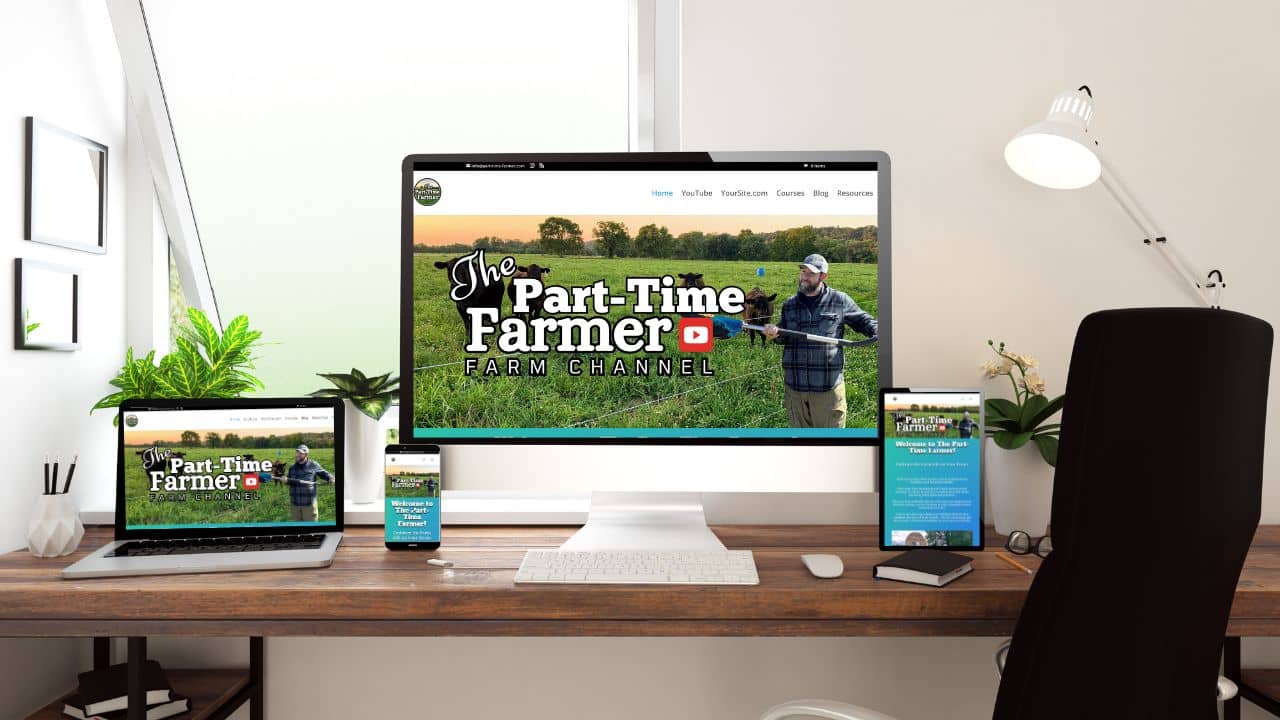
Your Farm Website Shouldn’t Feel Like a Second Job
I build it. I write your copy. I enter your products.
You send photos and details. I do the rest.
Simple pricing. Simple process. Completely managed by someone who actually farms.
Valuable Farm Marketing Insights at Your Fingertips

Missed a newsletter? Don’t worry! Access all past issues packed with practical tips and strategies to grow your farm business.
Affiliate Links: This email may contain affiliate links, which means we earn a small commission if you purchase through them—at no extra cost to you. We only recommend products we’ve personally used, tested, and truly believe in.
AI Disclosure: Every idea and opinion here is 100% human. I sometimes use AI to help with formatting, editing, or trimming things down—but the message is fully mine.